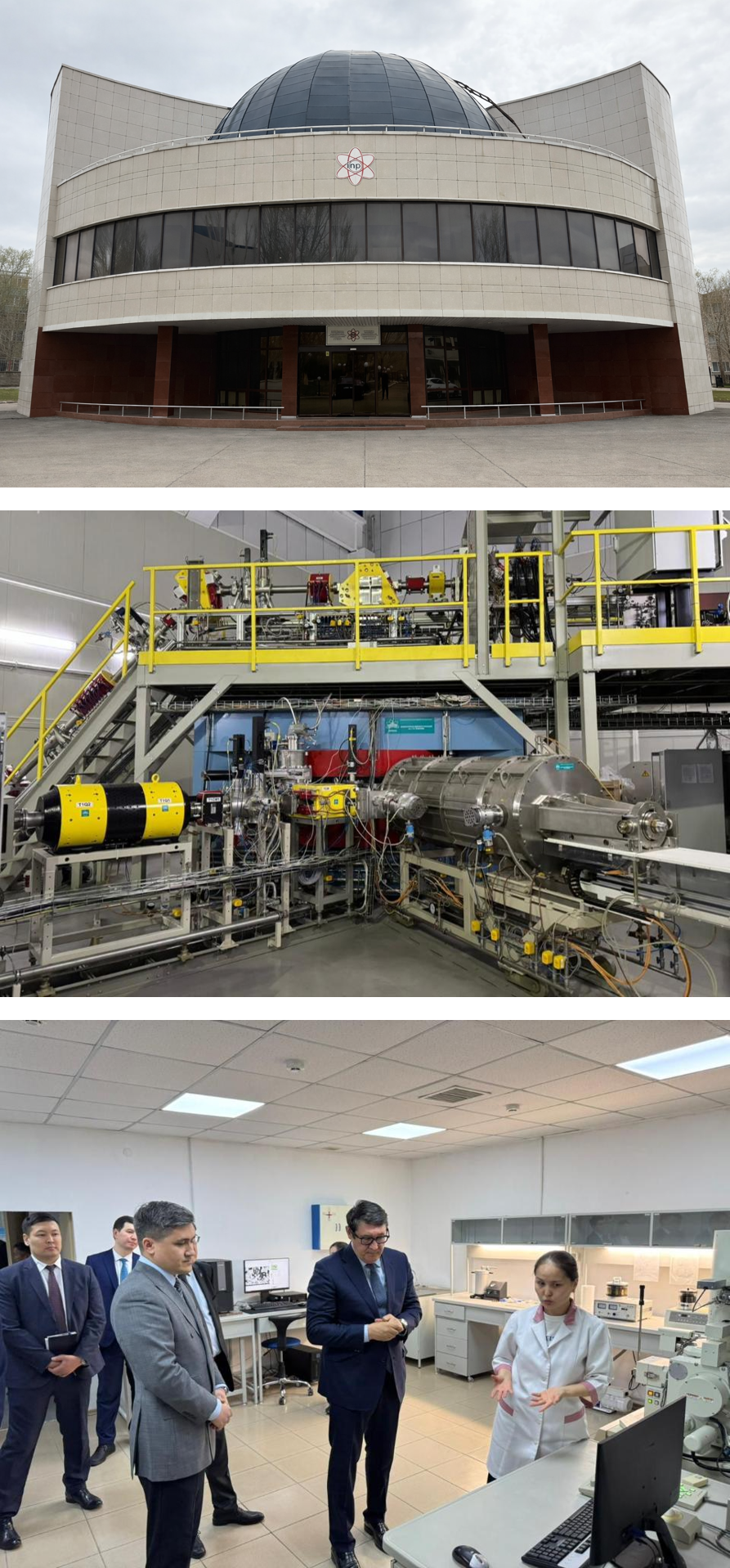
Astana branch
The Astana Branch of the Institute of Nuclear Physics of the Agency of the Republic of Kazakhstan for Atomic Energy is a multidisciplinary research center conducting fundamental and applied studies in nuclear physics, solid-state physics, radiation materials science, and track-etched membranes based on the DC-60 heavy ion accelerator complex. The branch carries out research on the fabrication and functionalization of track-etched membranes, the development of sorbents, catalysts, and membrane technologies for water purification, as well as the creation of sensors and energy storage systems. Considerable attention is given to the synthesis of nanomaterials, functional ceramics, and composites for microelectronics, energy, and nuclear technologies, including materials for reactors and fuel cells. The DC-60 accelerator complex also supports radiation and nuclear physics experiments, studies of irradiation processes and ion–matter interactions and enables interdisciplinary research involving various laboratories
Laboratory History
2001 – The project for the creation of the complex has been developed;
2006 – Physical launch of the DC-60 accelerator.
Main areas of activity
- Development of ion-track membranes and their functionalization, creating sorbents, catalysts, and membrane systems for aqueous purification, sensorics, and energy storage devices.
- Nanostructured materials science and the synthesis of functional materials for microelectronics, energy, and nuclear technologies, including composites, perovskites, and magnetic nanostructures.
- Research on the creation of nano- and microstructures, modification of polymers, metals, and semiconductors, ion implantation, and nuclear physics processes (transfer and radiative capture reactions) for astrophysical and thermonuclear applications.
- Training of highly qualified personnel in the field of nuclear energy.